


This article is part of the results of The Biggest Fleet 2025. Click here for all resultsBiggest Fleet 2025 shows the diversity of cleaning robot makers shaping today’s largest deployments
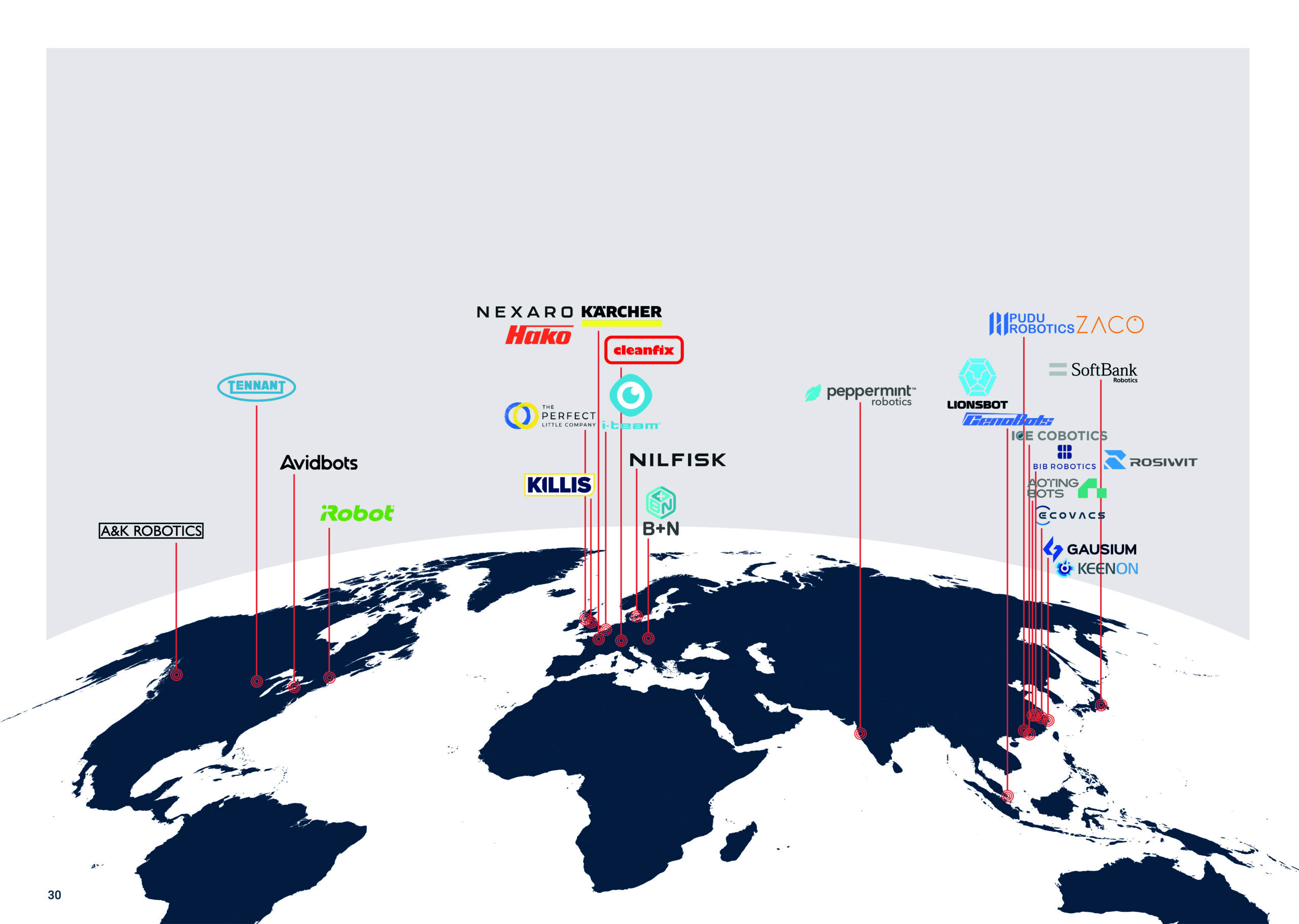
The 2025 ranking does not only highlight the operators of the world’s largest cleaning robot fleets. It also reveals the wide variety of manufacturers supplying those fleets. From global equipment giants to nimble start-ups, the field is highly fragmented, with no single vendor dominating across all sectors and geographies. Below, we have profiled every manu-facturer that appears in the 2025 ranking, with details on their background, technology, and the fleets in which their robots are deployed.
🇨🇦 A&K Robotics
Founded in 2015 in Vancouver, Canada, A&K Robotics specializes in retrofit autonomy kits that transform manual scrubber-dryers into self-driving units. The company’s “Cruz” module was piloted at the University of British Columbia and Vancouver International Airport. In Biggest Fleet 2025, A&K appears in the custodial fleet at the University of British Columbia, listed at position 56 with a Radar Score of 35. This reflects its focus on North American education and large public venues.
🇨🇳 Aoting Bots
Aoting Bots, established in 2017 in Hefei, China, is known for its waterless SW55 robot that can sweep, scrub, vacuum and dust-mop. By eliminating water, it targets factories, malls, and transit hubs where wet cleaning is impractical. In the 2025 ranking, Aoting Bots appears in a smaller Asian fleet with a Radar Score of 35, underscoring its niche position in sustainability-driven markets.
🇨🇦 Avidbots
Avidbots, founded in 2014 in Kitchener, Canada, builds large-format scrubber robots such as the Neo, designed for malls, airports and warehouses. Known for their robustness, Avidbots’ machines have been deployed across North America, Europe and Asia-Pacific. In Biggest Fleet 2025, Neo robots appear in Australian shopping centers and Singapore’s transit systems, with fleets reaching Radar Scores from 15 to 445. This confirms Avidbots’ role as a major supplier for high-traffic, large-scale facilities.
🇨🇳 BIB Robotics
BIB Robotics, founded in 2020 in China, is a newcomer that made headlines with FamilyMart in Japan. The convenience chain deployed 300 BIB robots equipped with displays and product baskets, doubling as both cleaners and promotional tools. In Biggest Fleet 2025, this fleet places prominently with a Radar Score of 300. BIB’s specialization in Asian retail settings demonstrates how robot makers can design for tightly constrained, high-density store formats.
🇨🇭 Cleanfix Reinigungssysteme
Cleanfix, a Swiss family business founded in 1975, introduced one of the earliest autonomous scrubbers, the RA660. Cleanfix also made an entrance into microbots in 2022 with the disk-shaped S170 Navi. In the 2025 ranking, Cleanfix robots appear in several healthcare and hospitality fleets in Switzerland, Germany, Singapore and the US, totaling around 250 units. Cleanfix exemplifies how a small European manufacturer can sustain relevance by focusing on specialized, challenging environments.
🇨🇳 CenoBots
Founded in 2021 in China, CenoBots develops compact, flexible scrubber-dryers suitable for schools, offices and labs. Despite its young age, the company has won customers on three continents. In Biggest Fleet 2025, CenoBots appear at Penn State University in the U.S. and at German industrial sites, giving the firm a Radar Score of 20. The company illustrates how upstarts can win footholds in niche markets with agile deployments.
🇨🇳 Ecovacs Professional
Ecovacs, established in 1998 in Suzhou, China, is widely known for its consumer Deebot vacuums. Its Professional division brings multifunction cleaning to commercial environments, with models like the PRO K1 and PRO M1. In the 2025 ranking, Ecovacs appears in Chinese retail and transport settings, with a combined Radar Score of 90. While still minor in commercial robotics, Ecovacs’ global reach and brand recognition suggest growth potential.
🇨🇳 Gausium
Founded in 2013 in Shanghai, Gausium (Gaussian Robotics) offers one of the widest portfolios in the industry, spanning compact vacuums to large scrubbers like the Scrubber 50 and Phantas. The company works with FM providers worldwide, from Atalian in France (55 robots) to Apleona in Germany and Huazhu Hotels in China. In Biggest Fleet 2025, Gausium appears across multiple fleets with combined Radar Score going into the thousands. Its broad base underlines its role as a global backbone of cleaning automation.
🇩🇪 Hako GmbH
Hako, founded in 1948 in Germany, is a long-standing maker of industrial cleaning equipment. Its Scrubmaster line has been adapted for autonomous operation through autonomy kits. In Biggest Fleet 2025, Hako robots appear in German FM fleets, notably Apleona (#18). Hako represents the incremental shift of traditional manufacturers into robotics.
🇨🇳 ICE Cobotics
Founded in 2011 in China, ICE Cobotics has built its reputation on compact autonomous scrubbers, marketed through a subscription-based business model. Its Cobi 18 is a small ride-behind scrubber designed for convenience stores and educational facilities. In Biggest Fleet 2025, ICE appears in several U.S. fleets: Kum & Go operates 400 Cobis (Radar Score 2000), RaceTrac runs 25, and J&H Family Stores 6, with additional deployments at Bowling Green State University. ICE also contributes to mixed fleets in Europe, such as Geiger FM in Germany.
🇺🇸 iRobot
iRobot, established in 1990 in the U.S., is the pioneer of consumer robot vacuums through its Roomba line. While not originally designed for professional use, Roombas occasionally appear in industrial adaptations. In the 2025 ranking, one German pharmaceutical company operates a huge fleet of modified Roombas for office and changing room maintenance (#26). This shows how consumer hardware can sometimes find unexpected roles in professional cleaning.
🇳🇱 i-team Global
Founded in 2015 in Eindhoven, Netherlands, i-team Global is known for its co-botic approach, combining human oversight with (semi-) autonomous machines. The Co-botic 1700 is among its best-selling robotic models. In Biggest Fleet 2025, i-team robots are used by German FM firms like Geiger and Dorfner. One all-i-team fleet stands out in particular: the Faxe municipality (#16) with 370 i-team microbots. i-team demonstrates the appeal of user-friendly, collaborative robots in Europe’s FM industry.
🇩🇪 Kärcher
Kärcher, headquartered in Winnenden, Germany, is one of the world’s largest cleaning equipment brands. Famous for pressure washers, it entered robotics with the KIRA B50 autonomous scrubber. In the 2025 ranking, Kärcher robots are present in European FM fleets such as Apleona and Dorfner. The company’s strength lies in its brand trust and integration into existing service contracts.
🇨🇳 Keenon Robotics
Keenon, based in Shanghai and founded in 2010, is globally recognized for delivery robots in restaurants and hotels. In 2023, it launched the Kleenbot C30, signaling its entry into cleaning robotics. While Keenon does not yet appear in Biggest Fleet 2025, its financial strength and service expertise suggest it may emerge strongly in the upcoming years. Industry observers expect it to leverage its service-robot success into professional cleaning.
🇬🇧 Killis Ltd.
Killis, based in Sheffield, UK, is a cleaning technology provider best known for its RoboVac Buddy, developed for Travelodge hotels. Around 7,500 of these compact vacuums are in service, placing Killis at the top of the 2025 ranking in Europe. This fleet demonstrates the viability of hotel-specific cleaning robots at scale, with Killis carving out the hospitality sector as its specialty.
🇸🇬 LionsBot
Founded in 2018 in Singapore, LionsBot is known for its debut model “LeoBot,” designed with an expressive personality and multifunction cleaning capabilities. One of the early players in the field partnerships span FM providers and transport operators. In the 2025 ranking, LionsBot robots appear in Singapore’s SMRT transit system, in British healthcare catering (Medirest), and with FM operators like Apleona Infra Services FM in Germany and Mitie in the UK. Combined, these fleets account for impressive Radar Scores. LionsBot’s rapid expansion illustrates how design-focused Asian start-ups can scale globally.
🇩🇪 Nexaro
Nexaro, founded in 2020 in Wuppertal as part of Vorwerk, focuses on autonomous vacuum robots for offices and hospitality. Its NR 1500 and 1700 models are is linked to the cloud-based Nexaro HUB. In Biggest Fleet 2025, Nexaro appears prominently in the German market, including Vebego Deutschland’s 160-unit deployment and other building service contractors. Nexaro highlights the rise of German mid-market innovation in Microbots.
🇩🇰 Nilfisk
Nilfisk, founded in 1906 in Denmark, has expanded from traditional equipment into autonomous scrubbers through its Liberty line. In Biggest Fleet 2025, Nilfisk appears in U.S. airports and European cleaning companies. Its integration of AI with a century-old brand positions Nilfisk as a global heavyweight in cleaning with big future potential.
🇮🇳 Peppermint Robotics
Peppermint Robotics, founded in 2019 in Pune, India, develops autonomous scrubbers for high-traffic environments like airports. In the 2025 Biggest Fleet ranking, the company operates 9 robots across three Indian airports—Mumbai, Thiruvananthapuram, and Ahmedabad—giving it a combined Radar Score of 45. This presence marks Peppermint as a strategic national player in showcasing Indian cleaning robotics.
🇨🇳 Pudu Robotics
Founded in 2016 in Shenzhen, China, Pudu is best known for its delivery robots but has rapidly expanded into cleaning with the CC1 and MT1. In Biggest Fleet 2025, Pudu is represented by several major operators: QuikTrip in the U.S. leads with 1,200 robots (Radar Score 6,000), Denner in Switzerland runs 200 units (Radar Score 1,000), and Aramark in the U.S. adds another 70 (Radar Score 350). Smaller fleets include Blechschmidt Induka in Germany and Marktkauf Prenzlau with 5 Pudu robots. Altogether, Pudu’s presence drives Radar Scores well above 7,000, making it one of the single most influential manufacturers in this year’s ranking.
🇭🇺 Robin (B+N Referencia Zrt.)
Robin is the proprietary cleaning robot of Hungarian FM provider B+N Referencia. Developed in-house since 2020, Robin is optimized for large public buildings. In the 2025 ranking, B+N operates 176 Robin units across hospitals and airports in Central Europe, yielding a Radar Score of 880. As an in-house fleet, Robin illustrates how FM companies can become robot OEMs in their own right.
🇨🇳 Rosiwit
Rosiwit Cobotics, founded in 2021 in China, is a fast-rising start-up with a diverse range of scrubbers, from compact Skywalker units to heavy-duty Titan machines. It has expanded into Eastern Europe with a Polish branch. In Biggest Fleet 2025, Rosiwit appears in one German fleet. The company exemplifies the new generation of challengers looking to gain international credibility through aggressive expansion.
🇯🇵 SoftBank Robotics
SoftBank Robotics, launched in 2014 in Japan, is known for its humanoid Pepper but found some commercial traction with its Whiz autonomous vacuum. Whiz robots are widely used in offices and supermarkets. In the 2025 ranking, Flagship Facility Services in the U.S. operates 100 Whiz units, and Japan’s Daiei supermarket chain fields 79, with smaller fleets in Europe. Together, they contribute substantial Radar Scores. Despite its strategic shift to an integrator, SoftBank Robotics’ hardware remains a benchmark in autonomous vacuuming for commercial sites.
🇺🇸 Tennant Company
Tennant, based in Minneapolis and founded in 1870, is a global cleaning machine manufacturer. In robotics, it partners with Brain Corp for autonomous ride-on scrubbers like the T7AMR. In Biggest Fleet 2025, Tennant is heavily represented: Walmart alone fields 1,850 units, Sam‘s Club hundreds more, and Schnucks adds dozens. These deployments make Tennant one of the single most widespread OEMs in large-scale retail fleets, with Radar Scores in the thousands.
🇬🇧 The Perfect Little Company (TPLC)
TPLC, founded in 2015 in Oxfordshire, UK, builds micro-vacuum robots branded as “Abbee.” These are designed for swarm operation, replacing manual vacuuming in offices and schools. In Biggest Fleet 2025, Mitie integrates 800 TPLC units alongside larger scrubbers, creating one of the few mixed fleets. TPLC demonstrates the scale potential of microbot swarms in FM contexts.
🇨🇳 Zaco
Zaco (ILIFE), founded in 2010 in Shenzhen, China, has evolved from a consumer vacuum pioneer into a versatile developer of compact cleaning robots. Known for cost-efficient design and global market reach, Zaco is now entering professional facility sectors with lightweight autonomous vacuums suited for small-to-medium spaces.
This article is part of the results of The Biggest Fleet 2025. Click here for all results